Oral history project honors century-old Millman dream
VILLAS — “We are looking for the children or grandchildren of the people who lived here first, who might know about the community,” said Tim Millaway, a documentarian collecting stories for an oral history project about Villas.
Millaway’s assignment is to create a record of the area as it was, is and soon will be, commemorating an important birthday with a commission from the New Jersey Humanities Board.
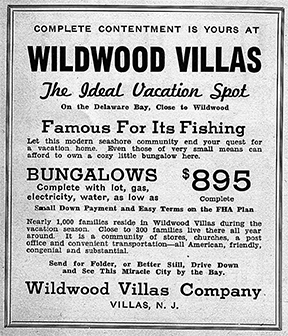
This oral history project, also sponsored by the Lower Township Historical Preservation Society, will be filled with the voices, the accents (changing in Cape May County even faster than Philadelphia) and, above all, the wild yarns of a town that advertised it was “Famous for its Fishing” in the first ads to grace the pages of the Philadelphia Inquirer back in the summer of ’26. That’s 1926.
It’s been one century since the first houses went up in the town then known as Wildwood Villas. Tiny, pretty bungalows hugged the western coastline on newly paved streets in one of the first communities on the cape to be built for automobiles.
The cottages originally had a recognizable Spanish flair, with white stucco and little covered porches under tiled roofs. Despite these romantic touches, Villas were not designed for millionaires. Not yet, anyway.
“The Millman houses, they were called,” Millaway said. “They didn’t even have foundations!”
Joe Millman was a man of vision, not construction code awareness.
“That’s why there are so few left,” Millaway deadpans. “They’re tearing them down to build new houses. The land is worth more.”
The land wasn’t particularly expensive then, and rumor has it that Millman won the whole shebang in a poker game. He built the first houses in time to open in the summer and promised affordable pleasures in diminutive cottages by the sea.
A Philadelphian of moderate means could buy one of these resort villas for $895 — with just $10 down. The new roads meant one could be on the Wildwood Boardwalk in about an hour.
Millman’s plans were curtailed by the stock market crash, and then the Depression, and much of the area had all but returned to its natural state by the advent of World War II.
Millman waited. He knew what he had, and he knew his day was coming. The Greatest Generation finished the war and got very busy in several key ways: they made babies, they fought Communism and they planned vacations.
The summer house was a status signifier and sanity saver in one: the children could swim, the wife could get away from their crowded city dwellings and the dads could commute in their shiny new cars. The new highway system meant one could get back to South Philly in about four hours.
“It was part of the American Dream,” Millaway said. “It’s part of the American Story, and we need to catch it before it’s gone.” He adds that with the 250th anniversary of the United States this year, there’s some hope this project could be linked with the bigger celebrations.
In addition to the documentary, and the oral history files to be kept for future historians, there are other events in the planning stages for later this year.
“The oral history is just the start of this project, leading up to a celebration day to be announced at a later date. We will be collecting oral histories, photos, maps and the like,” he said, adding Stephen Olszewski would be building a large panel to help visualize the centennial.
Olszewski is the artist behind the Greenbook Story and the America 250 story at the Welcome Center.
“Eventually, that art will go to the Foster House once its renovations are done. For now it will be at the Fishing Creek School,” where Millaway hosted a day of interviews. “We are setting up additional interviews for anyone with stories to tell.”
The interviews take only a few minutes, and the process is not frightening. More to the point, an oral history is not like going to court: people can discuss their family, a business they owned or worked for, even the local legends.
The important thing is to capture the voices, the names and as much of the unique culture of the Villas as possible.
The Greatest Generation is gone. But many of their descendants remain. Every house had at least one family, and each family had at least one story about this place. That’s all the documentarian is trying to find: the personalities, so unique, that together form a more complete picture of this place.
He’s already gathered some pieces that come as a surprise to people who grew up only a few miles away, like the so-called “Villas Henge,” where the setting sun moves north until it’s level with a particular street on the summer solstice, then glides south night by night.
The irony is that rising housing prices all over the state have led to something no one (except Joe Millman) could have foreseen: homes in the Villas are being listed at more than $1 million.
Not only do these homes have foundations (and heating, something the summer-only Millman houses often lacked), but many have pools and luxurious amenities the gadabout of the Roaring ’20s couldn’t imagine. That means the kind of changes the years alone couldn’t accomplish, gentrification could finish.
All the more reason to begin building a record of the people who lived here for the last 100 years, before even their descendants leave. After a day spent hosting a recording party, Millaway explained: “We put fliers up everywhere, and people came out, but they were shy,” he said, adding “though they did all have stories to share.”
He plans to start visiting local businesses to gather more, and even has a dedicated email account at [email protected] for anyone with a tale to tell.
“Every community has its own story,” said Millaway, who just last year finished a documentary about Union Bethel Cemetery, where Black Union soldiers of the American Civil War are buried in what is now Fishing Creek. That documentary is currently airing on NJ PBS. “But this one is so unique. We have to save the stories.”
By VICTORIA RECTOR/For the Star and Wave