Cape May Point State Park key gathering spot on Atlantic Flyway
CAPE MAY POINT — Cape May is not only a favorite escape from the hustle of everyday life, but it is also home to one of the world’s premier bird migration hubs — and the Cape May Bird Observatory (CMBO) is right at the center of the spectacle.
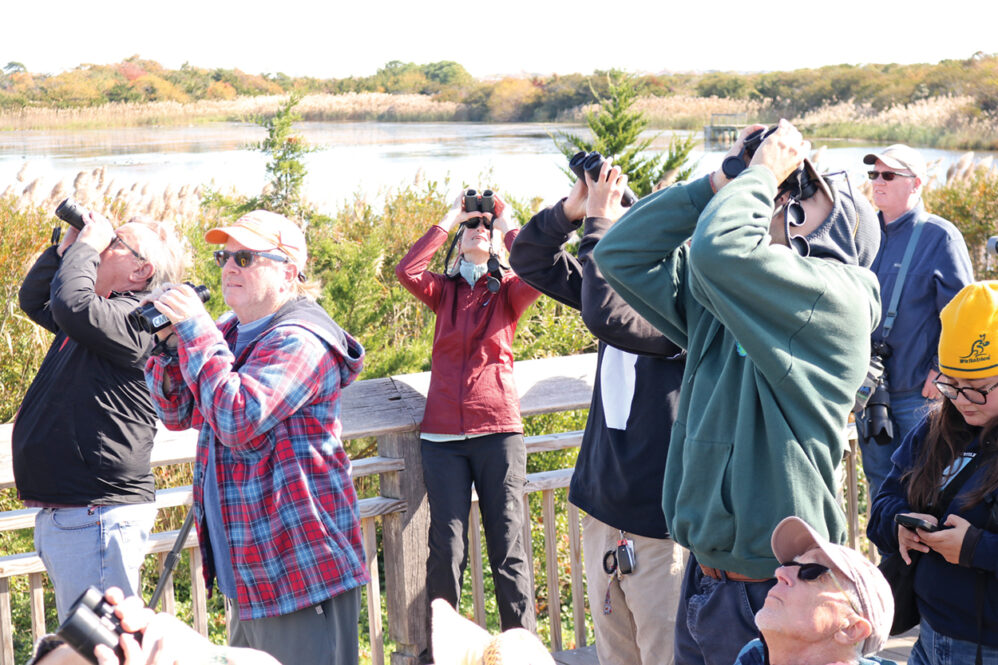
Late on Halloween morning, the CMBO hosted Hawks, Trails & Beach, an immersive guided observation tour along the Cape May Point nature trails to provide experienced birders and beginners, such as myself, a front-row seat to the action.
To better understand the moving parts of the different types of birds flying through this massive migration ecosystem, we need to get a good understanding of the numerous migration routes that run through Cape May Point State Park. The biggest route that passes through is the Atlantic Flyway.
The Atlantic Flyway is one of the four major superhighways that run through North America. The Atlantic Flyway is an intercontinental route that stretches down the Atlantic coastline from the Arctic tundra of Greenland and passes all the way down to the tropical landscapes of South America, and Cape May Point serves as a Grand Central Station for the millions of birds that travel along this flyway.
Leading us along the trail is Bert Hixon, a Stockton University graduate and local wildlife biologist heavily involved in research across southern New Jersey. To experts such as Hixon, the Cape May area is defined by four primary flight paths and monitoring operations, two of which are unique to the autumn season: the Morning Flight Reversal Corridor and the Peninsula Raptor Corridor.
These are the two routes that birders visiting the region this time of the year keep in mind as they observe and study the birds that are here among us at this time of the year.
Our first stop brings us to the observation deck at the end of the trail, where we spot two frequent, aggressive fliers: a red-tailed hawk and an American coot.
Starting with the red-tailed hawk, these predators in the sky have a large wingspan nearing 5 feet. This is great for the bird’s travel over land as it can catch rising columns of warm air, creating easier travel without exhausting much energy.
Unfortunately for the hawk, that advantage becomes useless once it reaches the peninsula since open bodies of water such as Delaware Bay do not produce rising columns of warm air. So, if you’re wondering why there are so many Red-tailed Hawks around us here at home, this is why. Crossing Delaware Bay requires continuous flapping, which would exhaust it since it was meant to soar. The red-tailed hawk does eventually cross the bay, but it waits for the right time when the wind can help it soar more efficiently across the 12-mile stretch of water.
Next, we have the American coot traveling on the Avalon Offshore Seabird route down to its winter home in the southern United States, the Gulf Coast and the Caribbean.
While they look like and hang around ducks, they are not ducks. These are defensive, territorial, charcoal-colored birds that spend their days at Cape May Point hanging out in tightly packed groups called “rafts” on the freshwater ponds — eating, resting and trying to avoid daytime predators in the sky.
When the twilight sunset turns into complete darkness, the American coot takes flight. These birds travel in scattered flocks but communicate with each other by making what can be described as a series of short, muffled, nasal laughs as they pass above in the November night sky.
As we made our way to our final observation point at the end of the inner trails of Cape May Point, we spotted a flock of northern pintails — fast-flying ducks capable of reaching speeds up to 65 mph. Their pitstop at the end of the peninsula is quick compared to other birds passing through, as they stay only for a few days at most. Upon arrival at Cape May Point, they instantly hydrate in the pond after hours of flying over the Atlantic coastline. As they settle in, they begin to tip their bodies completely upside down to eat wild celery, pondweed and marsh seeds from the mud at the bottom of the pond. After spending only a few days in Cape May, the northern pintails are ready to continue their long journey south.
Unlike the American coot, these birds have a more organized launch. During takeoff, the ducks explode vertically, straight up into the air from the water. The moment they clear the tree line, their organizational instincts lock into place as they arrange themselves into a strategic V-formation that helps them slice through headwinds and jet across the bay.
The final installment of Hawks, Trails & Beach is set for 10 a.m. to noon Nov. 7 at Cape May Point State Park. Register at njaudubon.org.
– STORY and PHOTO by COLTON VAN CLEAVE/For the Cape May Star and Wave
At top, birders take part in the Hawks, Trails & Beach tour hosted Oct. 31 by the Cape May Bird Observatory at Cape May Point State Park. The final tour of the season is set for Nov. 7.