
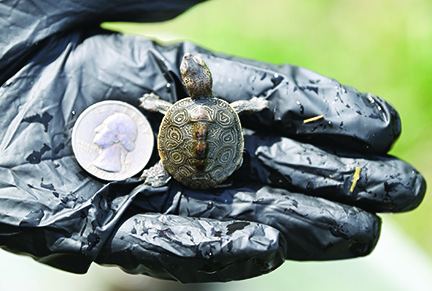
Obstacles, predators, car tires threaten quarter-sized reptiles
Diamondback terrapins are emerging from below ground on barrier islands, trying to make their way to the bay.
With bodies the size of a quarter, their journey in the spring and summer makes the odds of their survival low as they are trapped by street curbs and in storm drains and squashed beneath tires on streets.
They also can die from exhaustion when trapped on the hot asphalt or be eaten by a range of predators.
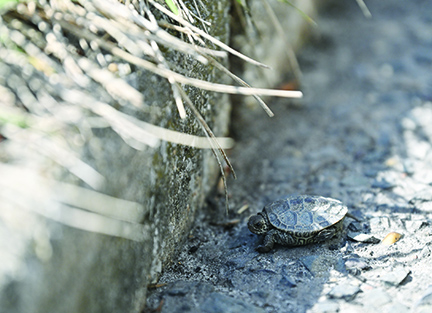
These little creatures can use a helping hand if they are stuck, but keep in mind it is illegal to keep them as pets. Leave hatchlings alone if they are in a marsh, but if found on a road or in a yard, here are quick tips to save them:
1. Gently pick up the hatchling and move it off the road.
2. Place it in a container with about a quarter-inch of room-temperature water, just enough to cover its feet, so it can rehydrate.
3. Take it to the nearest marsh as quickly as possible.
4. Find a location with lots of hiding places such as thick grass at the edge of a marsh.
5. Place the terrapin there in some fallen grasses — not in the water — to hide it from predators such as gulls, crows, foxes and raccoons.
For more information, contact the Stockton Vivarium at (609) 652-4581, the Wetlands Institute (wetlandsinstitute.org or Margate Terrapin Rescue Project (margateterrapinrescue.org).
In just part of a recent afternoon, volunteers working for the Stockton Vivarium, who are permitted to collect the hatchlings, found and saved about 40 little terrapins in Ocean City in just a few hours of looking carefully over a few streets.
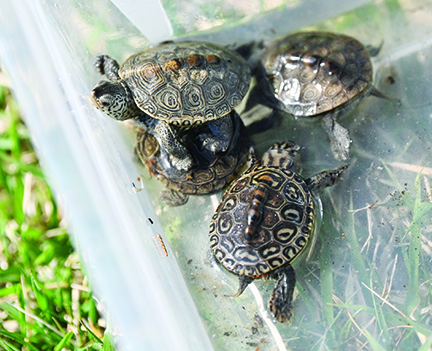
Ones found in storm drains (captured using small nets on long poles) were to be taken to the Vivarium. Those found on the street or by curbs were placed in shallow water to be released into the marsh.
Diamondback terrapins are the only North American turtle to live in brackish water, according to the volunteers.
Staff and volunteers from the Wetlands Institute in Stone Harbor have for decades conducted road patrols during the terrapin nesting season from May through August to help nesting females safely cross roads and to pick up injured and road-killed terrapins.
The institute provides aid to the injured or sends them to a rehabilitation professional. For those killed, researchers can sometimes retrieve viable eggs that are kept in incubators until they hatch and then raised in captivity for a year in the institute’s “head start” program, in collaboration with local schools and universities. They are then released into the wild.
According to the Wetlands Institute website, the organization spends resources to keep terrapins off the roads of Cape May County through its barrier fencing project that targets coastal road hotspots.
The Wetlands Institute also monitors the terrapin population with capture and release after tagging them with microchips.
The Wetlands Institute is at 1075 Stone Harbor Blvd. in Stone Harbor. Call (609) 368-1211.
By DAVID NAHAN/Cape May Star and Wave