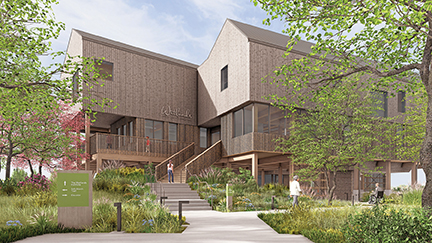
MIDDLE TOWNSHIP — The Wetlands Institute has unveiled plans for a reimagined campus, designed to strengthen its role as a leading center for coastal research, conservation and environmental education while creating a more resilient and welcoming gateway to the marsh for the community.
According to a news release, the vision for the future campus marks a significant step toward transforming the institute’s half-century-old facilities into a modern hub for research, conservation and public engagement.
The campus redesign was developed in collaboration with leading design and research partners and is based on a site plan concept developed in partnership with the University of Pennsylvania. It reflects an innovative approach to integrating marsh restoration, resilient design, and natural habitat restoration to confer resilience, the release states.
Trail elevation
A key component of the campus vision is elevating the Salt Marsh Trail. One of The Wetlands Institute’s most popular features with visitors, it is a vital access point for research and education and an important nesting area for diamondback terrapins. The work is scheduled to begin in October.
A grant valued at $3,075,000 through New Jersey’s Regional Greenhouse Gas Initiative Natural Climate Solutions program will fund marsh restoration and improvements to the trail. The project builds on the ongoing marsh revitalization work at adjacent Scotch Bonnet Island, where scientists and partners have been applying innovative methods to elevate and restore tidal marshes.
“The lessons we’re learning here at the institute are informing projects in New Jersey, and well beyond, including in coastal regions across the country,” said Lenore Tedesco, executive director of The Wetlands Institute. “By combining the Scotch Bonnet marsh restoration with the revitalization of the Salt Marsh Trail, we are linking a series of innovative approaches using nature to change things for the better for people, communities and wildlife,” she added.
According to the news release, the institute’s overall vision coupled with thoughtful deliberate planning will also help answer one of the most pressing questions facing coastal communities today: How can we live and build in the coastal zone in a way that is sustainable and beneficial to wildlife and habitat and that protects our communities?
Proposed new building
The institute has proposed a new building that would replace its current facility, constructed more than 50 years ago.
The original wooden structure was built to residential standards and meant for short-term seasonal operation. It no longer meets the needs of the organization’s growing research, conservation and education programs. In addition to limited classroom, exhibit, laboratory and administrative space, the existing building sits low on the marsh and has become increasingly vulnerable to flooding.
A dedicated team of architects and engineers continues to guide The Wetlands Institute and its board of trustees through the ongoing planning and approvals process. Plans call for the new building and grounds to be elevated to protect them against flooding.
The goal of the building design will be to maintain the coastal architectural character of today’s Institute while providing a modern, resilient infrastructure that supports the next generation of innovation and education.
The reimagined campus will include a revitalized marsh habitat, native plantings and improved visitor spaces designed to enhance both ecological health and the visitor experience, according to the release.
A pollinator garden, rain gardens and additional native landscaping will support biodiversity while blending naturally with the surrounding marsh environment.
The entire planting palette is designed to be climate resilient and benefit wildlife. The institute plans to seamlessly include a purpose-built sustainable building within this enhanced landscape.
“These plans are far more than just replacing a building,” Tedesco said. “We are reimagining the entire campus to better connect people with the marsh while strengthening our ability and capacity to conduct the research and restoration work that is so critical to protecting coastal ecosystems and communities.”
For more than five decades, The Wetlands Institute has been a cornerstone of the southern New Jersey coastal community. Generations of families have explored and learned about the marsh through its programs and exhibits. Hundreds of interns honed their scientific and educational skills through institute programs.
Dedicated volunteers and educators have helped protect thousands of diamondback terrapins, rescued more than a million horseshoe crabs, and created thousands of connections to engage tomorrow’s environmental stewards.
The institute temporarily ended public programming at its Stone Harbor Boulevard location as of Sept. 8. Staff will continue their work and be open to the public at a transitional location. The New Jersey Coastal Conservation Center at 600 N. Delsea Drive in Cape May Court House will house staff, education programs and the institute’s Tidepool Shop.
Research and conservation teams will continue their terrapin, marsh and coastal bird work. The institute will continue providing public programming and education programs from the NJCCC, including:
— Opening to the public for standard fall/winter weekend hours of 9:30 a.m. to 4:30 p.m. Saturdays and Sundays beginning Nov. 7.
— Offering school field trips, homeschool classes for the 2026-27 school year and scout programs.
“We’re excited to embark on the Salt Marsh Trail work this fall as we continue finalizing plans, receiving remaining approvals and raising funds to reimagine our campus,” Tedesco said. “We’re grateful for the community’s continued support and understanding as we work to create a sustainable home for the organization. Fundraising remains an important part of this work as we continue to raise the funds needed to bring this vision to life, alongside finalizing plans for a new building before returning to our Stone Harbor Boulevard home. Our reimagined campus will be a living demonstration of how coastal communities can thrive alongside the ecosystems that sustain them.”
“Everyone who enters our gateway will experience what’s possible when innovation, restoration, conservation and community come together,” Board Chair Annie Ulichney said. “Our goal is to create a place that inspires people, advances critical research and demonstrates how we can protect our coastal environments for generations to come.”
Learn more about the campus vision and proposed building at reimagine.wetlandsinstitute.org.