Congressman hopeful sand can be pumped by summer
OCEAN CITY — U.S. Rep. Jeff Van Drew is hopeful of delivering “tens of millions” of dollars in federal funding for beach replenishment before summer at the Jersey shore.
“We’re going to bring money into the district for beach nourishment, for these emergency areas, for these worst areas of erosion,” Van Drew said. “And when I say money, I mean significant amounts of money — not a half a million dollars, but it’s going to be in the tens of millions.”
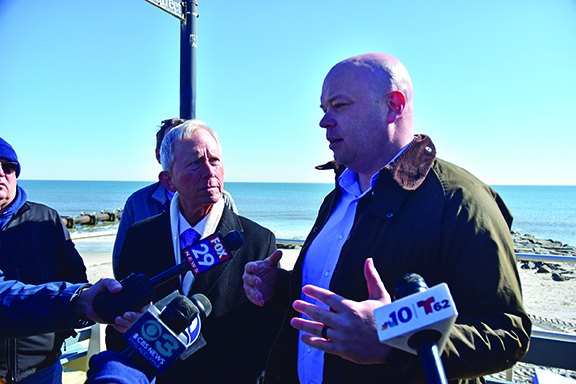
Van Drew, R-2nd, and Adam Telle, assistant secretary of the Army for Civil Works, evaluated the conditions Feb. 13 at Fifth Street in Ocean City, which has suffered extreme erosion since its last federally funded sand replenishment in 2022.
They later moved south to Strathmere in Upper Township, Avalon and North Wildwood, speaking of options for funding, the need for more competition in dredging along with the expanded use of dredge materials and longer-term options such as hard structures where needed and deemed appropriate.
“Those of us that know the shore and have lived here many, many years know that we have a cycle of life, and unfortunately sometimes it’s not an easy one — it’s a roller coaster ride,” Van Drew said.
The congressman addressed both short- and long-term goals for his district, which stretches from Cumberland County all the way up to Long Beach Island in Monmouth County.
Van Drew said that since he’s been in Congress, he has helped fund beach nourishment through a variety of sources such as earmarks, supplemental funding, transportation and infrastructure legislation as well as the remaining Hurricane Sandy funding.
“Multiple sources that we had to scrape together in order to continue to make sure we did what we need to do for our Jersey Shore,” he said, noting its importance to the economy.
“With that being said, Sandy money has run out, most of the transportation infrastructure money has run out. So we’ve got to look at other sources and other ideas,” Van Drew said.
Van Drew thanked Telle, who oversees the U.S. Army Corps of Engineers, for his efforts to bring the money to his district.
“We’re going to be delivering relief here to the citizens of South Jersey, the communities here in South Jersey, thanks to the leadership of Jeff Van Drew,” Telle said.
The assistant secretary said that on Feb. 23, Army Civil Works would unveil its biggest reform since 1986.
“It’s going to deliver more dredging, more flood-risk mitigation, more navigation for the country — and it’s all going to be called Building Infrastructure, Not Paperwork,” Telle said. “Our goal here is to get away from endless loops of government paperwork and get back to doing things like restoring the beaches here in New Jersey.”
Telle said because of the “technical process,” New Jersey was left out of federal funding for storms that affected it and its neighbors to the north and south.
“Thanks to Congressman Van Drew’s leadership, we’ve solved that technical problem, and that’s how we’re going to unlock this money for New Jersey,” he said.
Telle said the funding and equipment should be in place to put sand on beaches before summer.
“We’re optimistic that we can have the resources made available within a matter of a month or two, and the actual work and mobilization begins shortly thereafter,” he said.
Van Drew said projects would be prioritized based on both severity of the problem and where the community is on its replenishment cycle.
“Ocean City is due to have this done now, so Ocean City would certainly be one that would rank up there,” Van Drew said. “We’d like to do them all at once, but it’s not going to happen that way.”
Expanding dredging
The congressman also is looking into the expansion of dredging, noting Great Lakes Dredge & Dock Co. has a monopoly on the work in America.
“There’s no competition; there’s only one supplier. … We need to look at other areas where we can get a fair price, that we’ve got some competition,” he said.
The work is done in half the time at half the cost in other parts of the world, Van Drew said.
“We want to give the taxpayer the maximum benefit for their dollar. So we need that permanent source of funding. We also need to look at dredging and become more efficient and become better,” he said.
Telle said the Army Corps will begin using sand dredged from its navigation projects for beach replenishment, creating a new source.
“When we make sure that a channel is dredged, many times the material that comes from the bottom of that channel can be used to re-nourish beaches,” he said. “There’s a great side benefit of that activity, which is beach re-nourishment that can happen nearby.”
Other methods
Van Drew said a law passed last year that he championed studies hotspot erosion, addressing significant areas that cannot wait for a full replenishment.
“We’re looking at that to see if there are better ways to deal with that. You put sand there and it’s gone. We want to study that, and we’re working on doing things like that.”
He said there also will be more investigation of using permanent structures.
“Sometimes a permanent structure can be harmful; sometimes it can be good. We need to look into that more. It’s another piece of what we’re looking for,” Van Drew said. “We’re looking at dredging. We’re looking at whether permanent structure is called for. We’re looking at funding. These are all pieces to the puzzle. Short term, we’re doing this right now. There is an emergency now. Long term, we want to do this in a better way.”
Van Drew is working on legislation to create a permanent fund through oil and gas leases — making clear that New Jersey’s offshore waters are not an ideal location nor one targeted for exploration.
“The funding that’s collected from the offshore oil and gas production is used and repurposed. There’s no tax impact for it, no tax increase. The money would come from those leases and it would be a permanent source of funding so we don’t have this roller coaster ride,” he said.
Ocean City
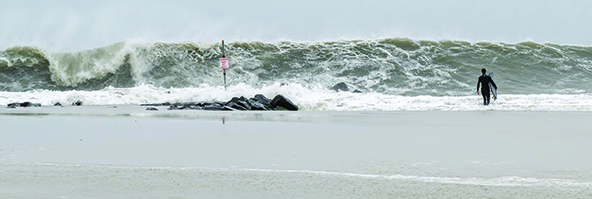
Looking out over the beach at Fifth Street, where boulders not seen for years were exposed to the sun and surf, Mayor Jay Gillian said the area is in poor shape.
“Everything you see here is (normally) under sand, and this, this was all under a dune. And then you can see over here, where it’s cliffed,” he said.
Van Drew said replenishment work would begin in Ocean City.
Gillian said the work would target First to 12th streets, the area hardest-hit by erosion.
“Our city now, three-quarters of it or even more is perfect. It’s just this north end they call the Q-tip where we have to just keep on doing it,” he said.
Replenishment work is about more than “just sitting on a beach, enjoying ourselves,” Gillian said.
He noted “tourism is one of the biggest industries in New Jersey,” but said public safety is more important.
“The biggest thing is protection for our homes and our neighbors,” Gillian said.
By CRAIG D. SCHENCK/Cape May Star and Wave