Presentation details mapping shipwreck, investigation that led to discovering identity
Scuba diver Dan Lieb spent about four years working to identify a wreck that sank two miles off the coast of Long Branch, N.J. In all, Lieb and his team made 24 dives at the site, located some 60 feet under the sea.
During the dives, they mapped the wreckage of the sunken vessel on the ocean floor and collected artifacts that would serve as clues to the vessel’s identity. Further, they thoroughly researched historical records. All of that led them to identify the wreck as the coal barge Plymouth.
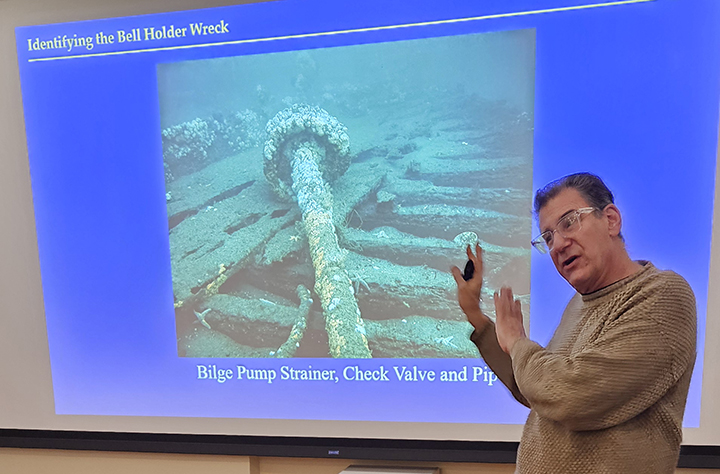
Lieb recently conducted a presentation on the wreck at the Cape May City Library. He and his team had dubbed the site the “Bell Holder Wreck,” after a bell holder they found during an early dive while the vessel’s identity remained a mystery.
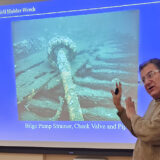
In addition to the bell holder, the dive team found an anchor capable of holding a 500-ton vessel in place, bilge pumps and the bottom of a rudder. Coal pieces off the vessel were no bigger than a fist, which meant they could be shoveled and used for domestic consumers.
Investigation of the wreck began in 1994. Lieb, who has led dozens of archaeological expeditions to identify shipwrecks in New Jersey for more than 30 years, was looking for a new wreck to investigate.
He asked friend Paul Hepler, a dive boat captain, for suggestions, and Hepler directed him to the site. Hepler referred to it as “Ruth’s Barge,” naming the site after his wife.
The breakthrough in the investigation came on a visit to the site in summer 1998, when six members of the New Jersey Historical Divers Association (NJHDA) conducted an extensive mapping of the vessel’s wreckage.
Each diver made three 30-minute dives, measuring the north, south and main sections of the wreckage spread across an area the size of a football field. Led by Lieb, the dive team consisted of Lieb’s wife Theresa, Jack Fullmer, Robert Harris, Howard Rothweiler and Lew Rosengrant.
Lieb noted that while technology has enabled photogrammetry, the use of photography in surveying and mapping to measure distances between objects, due to frequent low visibility he prefers classical means of mapping. In fact, the divers used vinyl measuring tapes and large nails for benchmarks on the wreck.
“I want to get in close, to be right there looking at the wreck,” Lieb said.
The team compared measurement results against certificates of registration at the National Archives for wrecks in the area. There were three possible candidates for wreck’s identity: the Plymouth, the William B. Diggs and the dredge Progress. They identified the Plymouth through a process of elimination.
Mapping of the site proved that the timbers used on the Bell Holder were too small to match the timbers on the William B. Diggs. Additional research showed the Diggs actually sank in southern New Jersey. The dive team learned the Progress was salvaged 10 days after she sank and anchored near the Statue of Liberty.
The Plymouth was a match. For comparison purposes, consider: The dive team measured the Bell Holder as 192 feet long. The Plymouth had a 199.2 registered length. The dive team estimated the Bell Holder’s width at 23.6 feet. The Plymouth had a registered width of 23.9 feet.
“You can’t get much closer than that,” Lieb said.
At that point, the team was confident the sunken vessel was the Plymouth.
“It was as if we put Cinderella’s foot in the glass slipper — it was a perfect fit,” said Lieb, a resident of Neptune, N.J.
Wood samples (oak, yellow pine and hackmatack) collected in 2003 solidified the team’s conclusion that they had, indeed, found the Plymouth.
Notably, diver David Raczkiewicz found the Plymouth’s bell in 2010. The bell and the bell holder are united and now on display at Divers Two in Avon-by-the-Sea.
During the library presentation, Lieb detailed the story of Plymouth’s sinking, which was recorded in official records and newspaper accounts.
On Jan. 16, 1924, the tugboat Harold was towing a line of barges — the Northern No. 8, followed by the Mobile, and then the Plymouth — from the Delaware Breakwater to the Port of New York. Both the Plymouth and the Mobile were carrying coal. The Northern No. 8 was transporting lumber.
They encountered a fierce storm with a freezing gale. They struggled against the storm.
“A gale can produce 25-foot seas. Because of the difficult conditions, the vessels were no longer in a row. They were slipping and sliding all over. It was difficult to keep them in a line,” Lieb said.
According to an NJHDA report, the hawser between the Harold and the Northern No. 8 snapped, “leaving the line of barges at the mercy of the seas.” Then the hawser between the Plymouth and the Mobile parted.
“The Mobile and the Plymouth collided. The Mobile probably slipped down a wave and rammed the Plymouth. It stoved a big hole in the Plymouth. She started to fill with water. She sank almost instantly,” Lieb said.
At some point, the hawser between the Northern No. 8 and the Mobile parted. Having broken loose from the tow, Northern No. 8 drifted with the storm and came ashore at Long Branch. She started to go to pieces. Her cargo floated as far away as Deal, N.J, where some locals helped themselves to the salvage.
Coast Guard stations in Long Branch, Deal and Monmouth responded to the rescue of the Northern No. 8. Notably, passing motorists aided local Coast Guardsmen in rescue efforts by turning their vehicles — most of which were probably Model Ts — off the road and shining their headlights onto the scene.
The Mobile stayed afloat. After standing with the Mobile overnight, the Harold proceeded into New York with the Mobile in tow.
The investigation into the disaster by the U.S. Steamboat Inspection Service found that no lives were lost and no one was injured.
More than 30 people attended the Bell Holder presentation.
“It’s fascinating how they put the details together to find the weight and the size of the sunken vessel,” said attendee Annie Mullock, a Cape May resident.
Cape May shipbuilder Wayne Whalen commented similarly on the dive team’s ability to accurately measure the sunken vessel.
Nancy Stevens, a Cape May resident, noted, “I like learning about anything to do with the water and shipwrecks. I’m a big Titanic fan.”
Mark Pfander, of Marmora, a new Scuba diver, likes hearing the stories about shipwrecks and learning about maritime history. His mother, Jennifer Pfander, commented, “I’m interested in history and grew up hearing the Sindia lore. There’s so much history here (at the Jersey shore).”
The Sindia, a ship en route from China and Japan to New York, became stranded on a sandbar Dec. 15, 1901, off 17th street in Ocean City. Members of Life Saving Station (LSS) 30 in Ocean City saved the 33-member crew. Evidence suggests the ship was intentionally grounded. It may have contained treasure — silver coins — looted from a Chinese bank and quickly taken off the ship.
Lieb said he’s always been interested in the sea and archeology. He grew up watching shows like “Diver Dan” and “Sea Hunt.” Lieb recounts being glued to the TV screen during the documentary series presented by oceanographer Jacques Cousteau.
In all, Lieb’s been diving for 52 years. He is president of the New Jersey Historical Divers Association and the director of the association’s New Jersey Shipwreck Museum in Wall. He serves as a trustee of the InfoAge Science and History Museums, also located in Wall, and is a trustee of the Squan Beach Life Saving Station Museum, located in Manasquan.
Statistics on sunken vessels may be somewhat surprising. Lieb noted that there are more than 4,200 documented shipwrecks off the coast of New Jersey, including World War II vessels sunk by torpedoes and World War I vessels sent to the depths of the sea by mines. Half of the wrecks are not identified.
Lieb and his team are doing their best to whittle down the number of unidentified wrecks. Currently, they are actively investigating wrecks off the coasts of Atlantic City and Spring Lake — with more investigations likely in the future.
By ALICE URBANSKI/For the Star and Wave