Program available to Cape May, West Cape May students
CAPE MAY — An opportunity exists for residents of Cape May and West Cape May who wish to place their 3- and 4-year-old children in a free preschool program.
Nestled in the halls of Cape May City Elementary School are four classrooms that house the state-funded program.
The full-day schedule offers a nurturing early education program for children.
According to Superintendent Zach Palombo, classes focus on social skills and independence in a small-classroom setting. The state-approved curriculum “Tools of the Mind” is used daily to provide a secure and safe learning experience that includes time for play.
“We recently received a state score from NJ Grow Kids and it showed that we are a quality program for early elementary education,” Palombo said.
The state Department of Human Services, under the Division of Family Development, has a Quality Rating and Improvement System for early childhood education that aims to raise standards across preschools.
The program is a collaborative initiative supported by the Departments of Children and Families, Education, Health and Human Services, to help families find quality care and provide education with resources.
Palombo, who oversees both West Cape May Elementary (WCMES) and Cape May City Elementary (CMCES), said he applied for a preschool grant for the Cape May school in 2021.
“The following year, I really pushed forward to move to a shared agreement where West Cape May [students] could come here,” Palombo said, adding that WCMES did not have the specs or layout to allow for a pre-K program under the Department of Education to happen.
At first, the program was small, and Palombo noted that parents were resistant because they were unfamiliar with it. He added that getting a jump on both academics and emotional and gross motor skills is an asset.
“We’ve been trying to communicate the value of having a balanced program,” he said. “Cape May and West Cape May have a symbiotic relationship because we share a lot of faculty and services together. We’re two small school districts on a barrier island, and our concern for us to stay healthy is to make sure we have students in the classroom seats.”
The preschool program has 60 seats available. Students from both schools are intermingled in the classrooms. Palombo noted that one-third of the student population is under age 5, which made sense for hosting the pre-K program at CMCES.
The classroom
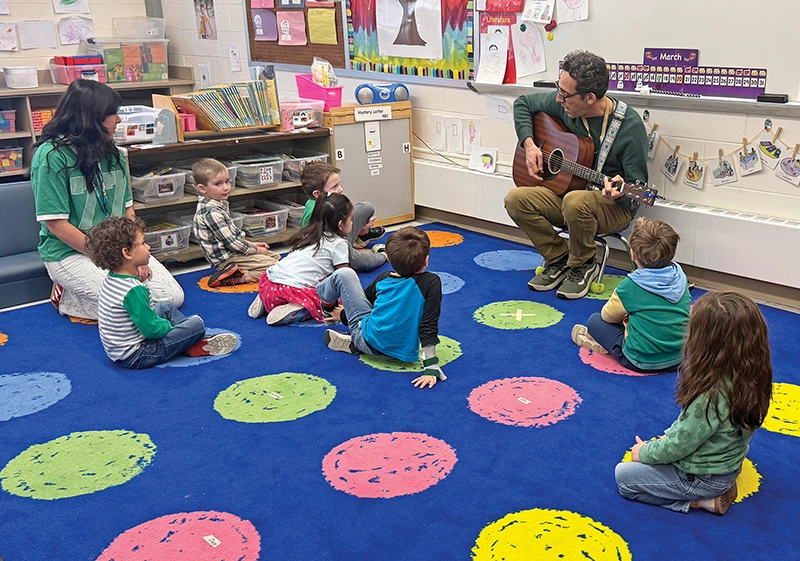
The creative and nurturing environment of the pre-K classrooms is a space for children to comfortably learn at an early stage.
To meet the Grow NJ Kids criteria, preschool instructional coach Leah McClure, supervisor of early education Lee Anne Tarr and several pre-K teachers collaboratively developed a variety of culturally responsive learning activities for the 2025-26 school year.
“Tools of the Mind” is a play-based curriculum that centers on a variety of themes to keep the ideas fresh and the children engaged. Currently, the children are learning a farm theme.
Other themes this year include family, restaurants, community workers, pet vet, beach and boardwalk, medical, grocery and camping.
Special classes such as gym, STEM, art and music are brought into the classroom. American Sign Language (ASL) is incorporated into the daily schedule once a week for 20 minutes. There also is rest time for children to lie down and calm their minds.
A day in the life of a pre-K student
Children are dropped off at 8:30 a.m. and are welcomed into the classroom with a free breakfast. The opening group includes that day’s calendar, a song and reading stories. The children get 30 minutes of recess daily. CMCES has a separate playground for the pre-K program.
“They have over an hour of play every day as well,” Tarr said. “They do something called ‘play planning’ where they’ll write or draw what center they want to go to. It’s individualized and allows for all different levels.”
Tarr said the program’s individualized levels are great because they range from students who just turned 3 by Oct. 1 to those who are 5.
“It allows them to reach their own potential and pace,” she said.
The students get to know each of the revolving specialists, McClure said. Palombo added that it allows the kids to see positive role models outside of their homes.
After playtime, there are small- and large-group instruction before lunch, followed by rest time. Special classes are brought into the classroom. Students are dismissed for pick up at 3 p.m.
Parental involvement
At the beginning of the school year, the program sends out a cultural survey to the families.
“It [helps us] recognize what they celebrate at home and their background, so we can infuse it into the classroom,” McClure said. “Also in our classrooms, we have multicultural literature, toys and different foods and music.”
Inclusive signage is incorporated into the preschool learning centers to help students consistently see diverse cultures, languages and family traditions. Parents and families are invited to share their traditions in the classroom.
Family communication is a key component of the preschool program. Family communication is conducted in both English and Spanish to expand accessibility. It includes letters, fliers, parent-teacher conferences, emails and online platforms.
Parental involvement is extremely important, which is why parent workshops are part of the curriculum, the staff said.
“We find it best that they enjoy when the students are also part of the workshop,” McClure said. “We’ve done ‘Tools of the Mind’ play, which is understanding the importance of play, and the parents got to play with the students in their play centers.”
In addition to workshops, there are various preschool program activities throughout the year for families to attend.
The preschool program has an Early Childhood Advisory Council composed of community members, school staff and Board of Education members.
“It’s a collaborative meeting where we try to get the community involved with activities in the preschool,” McClure said.
Tarr said one activity coming up is that a local farm is bringing a tractor for the kids to see. Other community involvement has included the Kiwanis Club of Cape May donating pumpkins for a pumpkin patch, the Cape May County Zoo to You program and visits from the Cape May City Fire and Police Department, and Coast Guard Partners in Education.
Additionally, the ECAC created a resource book for the school that includes community activities, social services, food banks and more.
“We specifically did a section of it for grandparents, because we do have some grandparents who are raising [children] or the family is living with the grandparents,” Tarr said. “It was important to make sure we include all ages.”
Enrollment
Enrollment applications for the preschool program are on a first-come, first-served basis. Parents and guardians can find the application at cmcboe.org.
U.S. Coast Guard families living on the base are encouraged to get information from the TRACEN website.
“We’ve had a waiting list in the past,” Palombo said. “When a spot has opened up and we call the parents, they felt like they hit the lottery because they have a chance to get a free educational program for their student, where they know for a fact that it’s fundamental academics.”
Palombo, Tarr and McClure emphasized that applying early is the best way to ensure students a seat in the preschool program.
“We feel very fortunate that we are able to provide the free education,” Tarr said.
Palombo added that he wished the state would recognize the shared service between the Cape May and West Cape May school districts.
“I would hope they would allow that expansion to go on there, because I know that there are some school districts within our county that don’t have the ability to have all their students in the pre-K program, but there are other districts having a hard time filling those seats,” Palombo said. “If the state could be a little more flexible in that regard, that would probably be beneficial for all students within this county.”
Consolidation study
The two school districts hired Stockton University last fall to perform a consolidation feasibility study.
The Southern Regional Institute and Educational Technology Training Center School of Education at Stockton is conducting the eight-month study that will analyze and present findings related to facility utilization, relationships between districts, administrative staffing, class size, diversity enhancement and debt obligations.
The findings are set to be presented to the public at 5 p.m. June 11 at the Lower Cape May Regional High School theater.
By RACHEL SHUBIN/Special to the Star and Wave