
Rescue swimmer remembered for giving life in service to others
CAPE MAY – We well remember Tyler Jaggers, and there is no better way to share details of his tragically short life than from a personal point of view.
In the fall of 2022, the pandemic was raging in the United States and the Coast Guard experienced a “bottleneck” in the training of its legendary Aviation Survival Technicians. More commonly known as rescue-swimmers, Aviation Survival Technicians, or ASTs, in their parlance, commence their Coast Guard careers like every other single Coast Guard enlisted person, here at the Training Center of Cape May, or TRACEN.
After enduring eight-weeks of “boot” camp, most recruits move onto “A” School where they receive specialized training in their chosen fields. A select few, very few, perhaps 75 individuals in a typical year, may qualify to attend a tortuous 24-week AST “A” School in Elizabeth City, N.C. With an attrition rate of 80-85 percent AST training is the most demanding ordeal of all the services, including that of even the storied SEALS, whose attrition rate hovers around 75% for their school. Thus, the Coast Guard’s AST community has always been very small, rarely more than 350 individuals worldwide.
Nevertheless, it seems that the lure of wearing that patch that identifies a person as a, Coast Guard Aviation Survival Technician, or Rescue Swimmer, is irresistible for a certain type of person, and Tyler Jaggers was just that type of person.
Due to that pandemic “bottleneck,” a plug of AST candidates (usually referred to as, “ASTC’s) accumulated in Cape May during the autumn of 2022. They were put to good use as gym staff, swim instructors and lifeguards for the base’s 50-meter indoor pool. When not instructing, guarding or otherwise engaged, they were subjected to locally designed, pre-AST training torture sessions, conducted by Aviation Survival Technician (AST) Petty Officer 1st Class Chris Wilson. An experienced rescue swimmer himself, Wilson was adamant about instilling in Cape May’s future ASTs an appreciation for the importance of extreme conditioning both physical and mental. Along with another experienced rescue swimmer, Chief Ben Morris, Wilson instituted a program of grueling, lung-searing challenges that replicated real-world scenarios that Wilson himself had encountered during his many rescues.
According to Wilson, “I want future ASTs to learn that on those occasions when they’re totally spent and exhausted, they have to find that untapped reservoir of strength, because somebody’s life, maybe their own, depends on it.”
That fall, the Training Center of Cape May, in conjunction with the Red Cross, prepared for its annual “Operation Fireside.” Conducted since 1981, on both Thanksgiving and Christmas, Operation Fireside is when Cape May families open up their homes and hearths to recruits who are enduring their eight weeks of basic training or boot camp. My wife and I are one of those families. In fact, hosting two or more recruits for those important holidays had become a treasured tradition in our own home, but 2022 was different.
Due to the pandemic, Operation Fireside was largely scaled back since the number of recruits was greatly diminished that year. Interestingly, at the same time both my wife and I had interacted with the unusually large number of recent recruits who were then assigned as pool instructors and lifeguards. These were the ASTC’s who were waiting to attend AST “A” School. Therefore, we extended an open invitation for this group of ASTC “Coasties,” who were stuck between boot camp and AST training, and invited them to share Thanksgiving with us at our home.
So it was that year, nine AST candidates joined us for Thanksgiving. One was a young man named Tyler Jaggers.
At one point while Tyler was visiting our home that Thanksgiving, I noticed him carefully studying a shadow box containing my own military awards and decorations. The shadow box hung next to a photograph of my F-4 Phantom fighter. We talked a long time about my career and exploits in the Marine Corps and Air Force and he seemed to absorb every word. I noticed that he was in the process of growing a mustache. Having sported a mustache myself for almost seven decades, I complimented him on his and received a big, Tyler Jaggers grin in return.
Yeah, I liked this kid. As a “girl-dad,” I can say emphatically, that Tyler Jaggers was the type of young man that every, “girl-dad” hopes his daughter will bring home. I bet that his fiancé’s dad feels the same way.
Although not a surfer himself, Tyler was what surfers call a “waterman.” He embodied a lifestyle that was connected intrinsically to the ocean, a lifestyle that sought challenges, the more physical and riskier, the better.
No surprise, while in Cape May Tyler Jaggers gravitated to and joined the prestigious Cape May Beach Patrol, a tight-knit group of avid watermen and women dedicated to ensuring that Cape May’s beaches are the safest beaches in New Jersey. Tyler shared a bench with Damien Cwik, son of legendary Cape May lifeguard Bob Cwik.
Damien relates, “We guarded the Cove Beach together, two years, I think. We all called him, “Jagger,” as in Nick Jagger of the Rolling Stones. One thing I can tell you about him was that he had a plan. He was determined to be a Coast Guard Rescue Swimmer and everything he did, especially in terms of his physical fitness, moved him toward that objective.”
When the bottleneck cleared in early 2023, Cape May’s AST candidates, Tyler Jaggers among them, finally began making their way to Elizabeth City for the ultimate test, AST training. AST training is comprehensive. In order to complete, candidates are expected to master helicopter deployment, multiple rescue techniques and specific technical skills, even including aircraft servicing. Significantly, they are required to complete training as emergency medical technicians, EMTs.
The sum of AST training demands the very highest level of physical fitness combined with mental acuity while all the time expecting uncompromising military bearing. Thanks in large part to Wilson’s unrelenting, rigorous training back in Cape May, Jaggers successfully completed the AST School and moved onto his first, real-world assignment. During that first assignment, the new AST was recognized for superior performance by the Secretary of Homeland Security while assigned as a crew member aboard the U.S. Coast Guard Cutter Legare during operations in the Caribbean Sea. Next, in April 2024, he moved on to a new assignment at the Coast Guard Air Station in Astoria, Oregon.
When a crewman aboard a vessel far out to sea suffers a life-threatening stroke, who does the captain of the vessel call? The United States Coast Guard, of course.
And who does the Coast Guard send to the rescue? Rescue Swimmer Tyler Jaggers along with the crew of an MH-60 Jayhawk out of Astoria.
This required a long flight by helicopter over a cold Pacific during the dead of winter, not an easy task even in summer.
Details are still being ascertained, but what we know for certain is that on Feb. 27, 2026, Tyler Jaggers was the rescue swimmer aboard an MH-60 Jayhawk that deployed to a large vessel some 120 nautical miles west of Cape Flattery, Wash. During the complicated medevac that followed, Jaggers suffered a severe injury.
Transported to Madigan Army Medical Center at Joint Base Lewis-McChord in Tacoma, Wash., he succumbed to his injuries on March 5.
Admiral Kevin Lunday, commandant of the U.S. Coast Guard, summed up the loss of Tyler Jaggers this way: “He demonstrated extraordinary heroism in the face of danger, upholding the highest standards of courage and excellence for Coast Guard operations. We honor his selfless actions and unwavering devotion to our highest calling, to save others.”
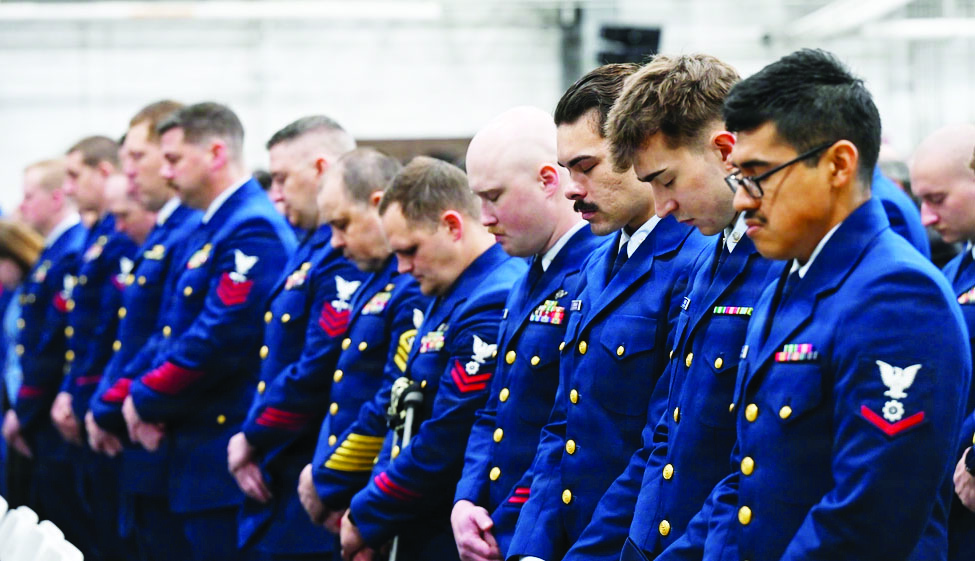
Friends and family of Petty Officer 2nd Class Tyler Jaggers during a memorial service March 20 at Coast Guard Air Station Astoria. (Photo by Petty Officer 3rd Class William Kirk. Official photos courtesy of the Public Affairs Officer, TRACEN, Cape May.
The Coast Guard Helicopter Rescue Swimmer Association was succinct, “He gave his life in the purest act of service, trying to save another. Our brother put his life on the line for someone he had never met, as Coast Guard air crews and rescue swimmers have done thousands of times before, answering the call that he and his crew could save a stranger’s life.”
Looking back, I clearly remember the day I came into the locker room and Tyler was clearing out his gear; his locker was adjacent to my own. Orders in hand, he was off to Elizabeth City, a possible marriage and adventures as a Coast Guard rescue swimmer were in his future … and that mustache was looking pretty darn good, too.
If I could visit with Tyler Jaggers one more time, I would shake his hand then cite the unofficial motto of Coast Guard rescue swimmers, “That others may live.”
But alas, until we meet up again in Valhalla, the legendary hall of heroes, I’ll have to settle for wishing Tyler, “fair winds and following seas, my young friend.”
Tyler’s name has long since been removed from that adjacent locker, AST 1/C Wilson has moved on to a new assignment and Chief Ben Morris retired from the Coast Guard and is now pastor at Cape May Baptist Church.
Tyler Jagger’s legacy remains embodied in the courage and devotion of his fellow rescue swimmers and, for those who knew him, that unmistakable Tyler Jaggers grin. Godspeed, Tyler.

By MARK ALLEN/For the Star and Wave
Mark Allen is a retired lieutenant colonel with 27 years’ flying experience with the U.S. Marines and Air Force National Guard. The Other Side radio show is broadcast noon to 2 p.m. Fridays on WCFA-101.5 FM.