Lower Township historian Pary Tell shares their exploits in Upper Township presentation
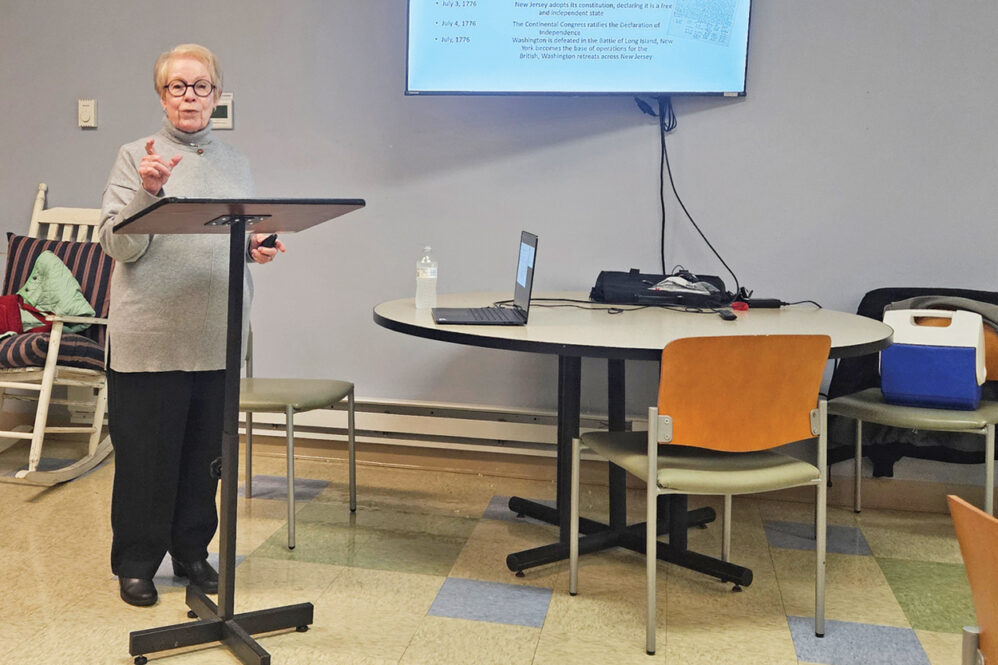
UPPER TOWNSHIP — “Women managed the homefront. They served as spies and combatants. They supplied the Continental Army with food, clothing and ammunition while boycotting British goods,” local historian Pary Tell said last week.
They also operated farms and businesses in their husbands’ absences, fundamentally sustaining the war effort, Tell added during a recent meeting of the Historical Preservation Society of Upper Township
Tell presented “Jersey Girls and the Fight for Freedom,” detailing the exploits of courageous New Jersey women such as Molly Pitcher and Patience Lovell Wright, who were heroines in the American Revolutionary War.
The Jersey Girls were representative of large segments of women who made major contributions to the patriot cause. Although their efforts were often overlooked, women played critical, diverse roles in the Revolution, noted Tell, chair of the Lower Township Historic Preservation Commission and curator of the Wildwood Historical Museum.
Here’s a look at the Jersey Girls:
— Mary Hayes McCauley (Molly Pitcher)
Mary Ludwig was born around 1754. She married James Hayes in 1769. Mary was a “camp follower.” Typically, camp followers traveled with the army and performed the cooking, laundry and nursing duties. Mary followed her husband when he enlisted in the artillery in June 1777 as a gunner.
Mary was with him at the Battle of Monmouth on June 28, 1778. She was carrying water for the men to drink, but more importantly, to use to cool down overheating cannons. (Mary served as the historical inspiration for the legendary name “Molly Pitcher.” All of the women who carried water were called Molly Pitcher.)
When Mary’s husband was wounded, she took his place swabbing the cannon and shooting. During the battle, an enemy cannonball shot between Mary’s legs, tearing away the bottom of her petticoat but leaving her uninjured. (A bit of trivia: It’s said Mary chewed tobacco and swore like a soldier.)
She and her husband moved to Carlisle, Pa. After her husband died in 1786, she married John McCauley, also a Revolutionary War veteran.
“He was abusive,” Tell said. “He disappeared.”
Mary died in 1832 and was buried in Carlisle, where a monument was erected in her honor.
— Margaret Kemble Gage
Margaret was born in New Brunswick and married British Gen. Thomas Gage on Dec. 8, 1758.
When Gage was sent to Boston to put down the colonial rebellion, Margaret became an informant. The Americans knew that the British planned to advance to Lexington and on to Concord, where the rebels were storing munitions. However, they didn’t know if the British were going to march or take small boats across Boston Bay.
Gage confided in his wife that the route would be by sea (bay). Circumstantial evidence suggests that she was the informant who warned the Massachusetts militia about the sea route.
Some background: “One if by land and two if by sea” refers to a secret lantern signal used on the night of April 18, 1775, to warn colonial militia which route the British troops were taking. The phrase comes from Henry Wadsworth Longfellow’s famous 1860 poem “Paul Revere’s Ride.” Two lanterns were hung in the steeple of Boston’s Old North Church to alert patriots waiting across the bay in Charlestown that the British were coming by sea.
The poem has Revere waiting across the Charles River, which ends in the bay, for the signal so he would know which way to ride. Actually, he already knew the route but had the lanterns hung as a backup alert. Revere was captured in Lincoln along the road between Lexington and Concord, but another rider made it through to Concord. Secondary riders spread the alert.
“Gage didn’t turn Margaret in because he truly loved her,” Tell said. However, he did ship her back to England. After he was relieved of his command, he joined her.
— Theodosia Bartow Prevost Burr
Theodosia was born in 1746. In 1763, she married British Army officer James Marcus Prevost in New York City. When James was called back to active duty in the Royal American Regiment in 1776, she had to take charge of their home, along with their five children, her mother and her teenage half-sister.
To hold off patriots wanting to take her property because her husband was a British Army officer, she invited George Washington to stay at their home when he was in the area. She met Aaron Burr, and maintained a correspondence with him for years. After her husband died, she married Burr. (Trivia: She was 12 years older.)
— Patience Lovell Wright
Born on Long Island in 1725, Patience lived in Bordentown from the age of 4. At 21, she moved to Philadelphia to study art, especially sculpting.
Patience’s husband died unexpectedly in 1769 and her older sister Rachel, also a widow, suggested they start a business making sculptures out of wax — a newly popular material.
Benjamin Franklin’s sister suggested that Patience move her business to London. Throughout the conflict between the patriots and the British, she sent letters to the Continental Congress reporting whatever military and political news came her way in her many business and social conversations.
She smuggled out some of these letters by inserting them inside the heads of wax statues that she sent to Rachel’s salon in Philadelphia.
— Mary Creighton Stratton
Mary was born in 1762 in Haddonfield. Her father operated a fulling mill and her mother operated the Indian King Tavern.
Mary witnessed troop movement from both the Continental Army and British Army. Continental soldiers and militiamen marched through Haddonfield on their way to Fort Mercer, followed by Hessian soldiers.
In April 1778, the British entered the town and plundered the tavern. They took food, clothing and supplies and set fire to two houses. In June, after leaving Philadelphia heading for Monmouth, the British soldiers again ransacked the tavern.
— The Ladies of Trenton
More than 60 prominent women, known as the Ladies of Trenton, raised money to purchase clothing, food and other supplies for the Continental Army. Members of the group included:
Martha Cadwalader Dagworthy, wife of Gen. John Dagworthy; Annis Boudinot Stockton, wife of Richard Stockton, a signer of the Declaration of Independence; and Mary Bloomfield, wife of Joseph Bloomfield, captain of the 3rd New Jersey Regiment, clerk of the New Jersey General Assembly.
Notably, Martha Washington and other generals’ wives stockpiled food to deliver to the Continental Army’s winter camps.
Boycotting
Women supported boycotts of British goods by spinning and weaving their own fabrics for clothing. Women refused to purchase British imports of household goods such as fine china and furniture.
“No one drank tea,” Tell said.
In Edentown, N.C., Penelope Barker organized a boycott of British goods in 1774 orchestrated by a group of women known as the Edentown Tea Party. It was the first recorded women’s political demonstration in America.
Quiet in Cape May County
Fortunately, Cape May County was not directly affected by the war, Tell said. However, men were on the lookout in Stone Harbor, Wildwood and Cape May for British troops.
“They had a communication system like the Pony Express. If they saw British naval troop movement, they would get information to the Continental Congress in Philadelphia in a day,” Tell noted.
Giving women their due
“Most people know there’s an army fighting — in any war — but they don’t stop to think about what everyone else has to do to keep that army going. People think about the battles and who won but not about what everyone else contributed to the army being successful,” Tell said.
“As the Jersey Girls show, New Jersey women rallied to support the patriot cause,” she added. “Some were heroes in the battlefield; others stuck close to the hearth knitting mittens. Everyone did their part.”
– STORY and PHOTOS by ALICE URBANSKI/For the Cape May Star and Wave