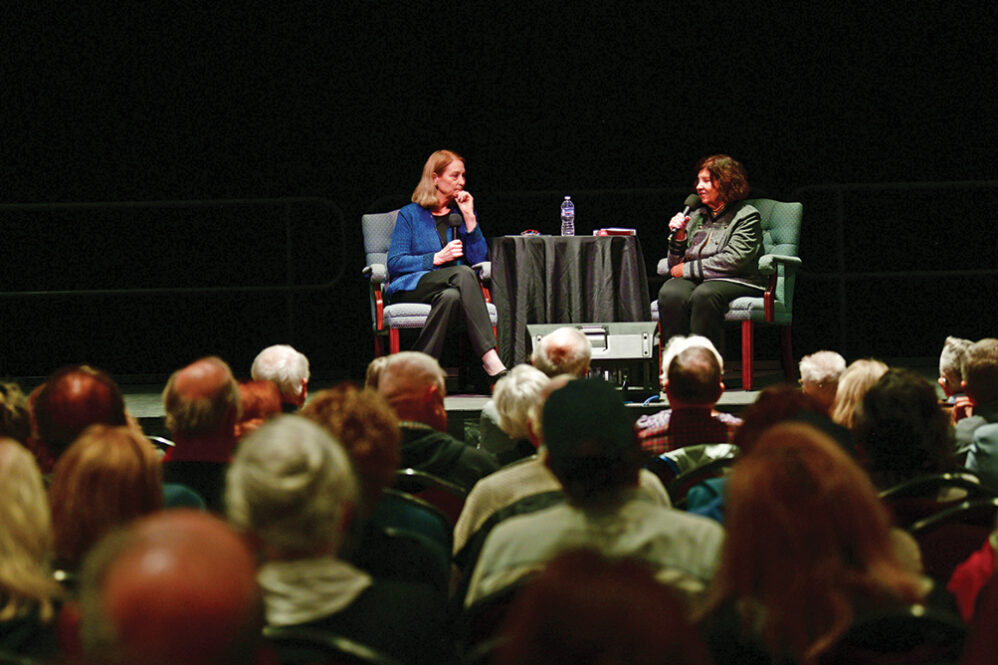
CAPE MAY — Nearly 300 people came out to Cape May Convention Hall on Oct. 11 to hear internationally and nationally renowned author and national security expert Susan Eisenhower share lessons from her grandfather, Dwight D. (“Ike”) Eisenhower, Supreme Commander of Allied Forces in Western Europe during World War II and 34th president of the United States.
Eisenhower shared insights from her recent book, “How Ike Led: The Principles Behind Eisenhower’s Biggest Decisions.” She is a national security expert with an illustrious Washington career as an author and analyst.
Focusing on Eisenhower’s strategic decisions as a world leader, she also shared personal insights gleaned from her life growing up at the family farm in Gettysburg, including anecdotes that revealed her grandfather as a warm, kind, passionate person.
The Cape May MAC (Museums + Arts + Culture) annual Lessons of History Distinguished Lecture Series brings renowned speakers to Cape May to offer illuminating insights within their respective fields. Eisenhower presented the series’ 14th annual lecture: “Contemporary Ike: The Art of Strategic Leadership.”
Ike, she said, had a unique genius for the big-picture approach to strategic decision making, as both a world leader in the military and as president.
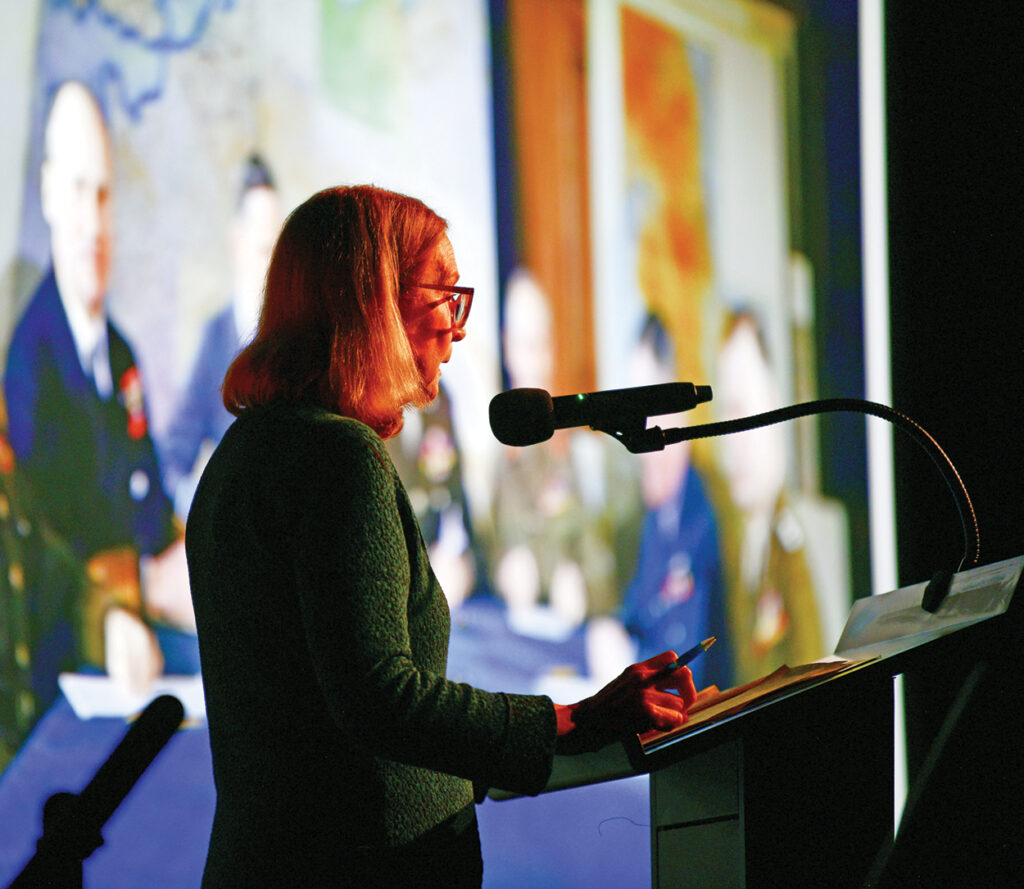
“He had integrated American and other allied forces and more into a single cohesive unit. He had to integrate the services of land, sea and air for the first time in military history. He had to integrate the forces with different command structures, different strategic doctrines, different languages and a set of completely different national interests in some cases.”
Eisenhower was a dedicated diarist, she said.
“He wanted to take his worries only to his own pillow because he understood that optimism and hope were mobilizing factors and absolutely central to maintaining morale. No matter how difficult the task was, he thought that one of the most important things he had to do was to always remain optimistic.”
She reminded the audience of the magnitude of the Second World War, and the complexity of the D-Day invasion.
“I’m sure you’re aware of the enormous size of the D-Day invasion. There were 570,000 tons of supplies, 12,000 aircraft support, 195,000 naval personnel, 156,000 troops along a 50-mile coast facing 50 German divisions, and we had to get onshore in less than 24 hours. It was a war of vast dimensions. The total estimated human life loss caused by World War II was roughly 72 million people.”
She described Eisenhower’s ethos as “leadership by self-denial,” and quoted from his memoirs:
“This is a long, tough road we have to travel. Men who can do things are going to be sought out as surely as the sun rises in the morning. Fake reputations, habits of glib and clever speech, and glittering surface performance are going to be discovered and kicked overboard. A man’s got to forget himself and his personal fortunes. I’ve relieved two seniors here because they got to worrying about injustice, unfairness and prestige.”
“He only wanted people serious about the job,” she said. “He was as tough as he always had to be. But having said that, he brought enormous support to those who were prepared to do the job and to accept humility.
“A platoon leader, he went on to say, doesn’t get his platoon to go by shouting, ‘I am smarter, I am bigger, I am stronger, I am the leader.’ He gets men to go along with him because they want to do it for him and they believe in him.”
Eisenhower was a Republican at a time when the party was blamed for causing the Great Depression and had not held the presidency for decades. Eisenhower brought his unparalleled military experience to the presidency, Ms. Eisenhower said.
He sought and got unprecedented support from both sides of the aisle for more than 90 percent of his presidential initiatives, and was extraordinarily able to bring opposite sides together in the political realm.
As he integrated the military during the Battle of the Bulge, going against Army protocol, establishing what he called a “beachhead,” he laid the groundwork for the civil rights movement. He sent in the 101st Airborne Division to escort the Little Rock Nine to Central High School and enforce school desegregation.
Patricia O’Connor of Cape May was in the audience.
“I thought it was exceptional. I did not realize how forward Eisenhower was on many of today’s very important issues having to do with diversity — progressive issues we would call them today. And I think it’s so important to come together to solve today’s issues,” she said.
“I was in junior high and high school during the Eisenhower years, and I remember them extremely well,” said Myles Martel, who founded the Lessons of History Distinguished Lecture Series in partnership with Cape May MAC in 2012. “I felt that Susan did a magnificent job today. She was a credit to MAC, she was a great credit to the Lessons of History, she was a credit to the legacy of her family. She’s an extremely approachable, lovely human being and the program was just absolutely outstanding. We had so many great programs and this is right up there near if not at the top of the list.”
“We’re so honored to have Ms. Eisenhower as this year’s presenter and thankful for the wonderful turnout,” Cape May MAC Director and CEO Jody Alessandrine said. “Cape May MAC is proud to consistently provide Cape May with a wide variety of extraordinary educational programming. Also, we’re proud to have helped create such a lively and impactful series that reinforces just how knowledgeable and engaged our community is.”